

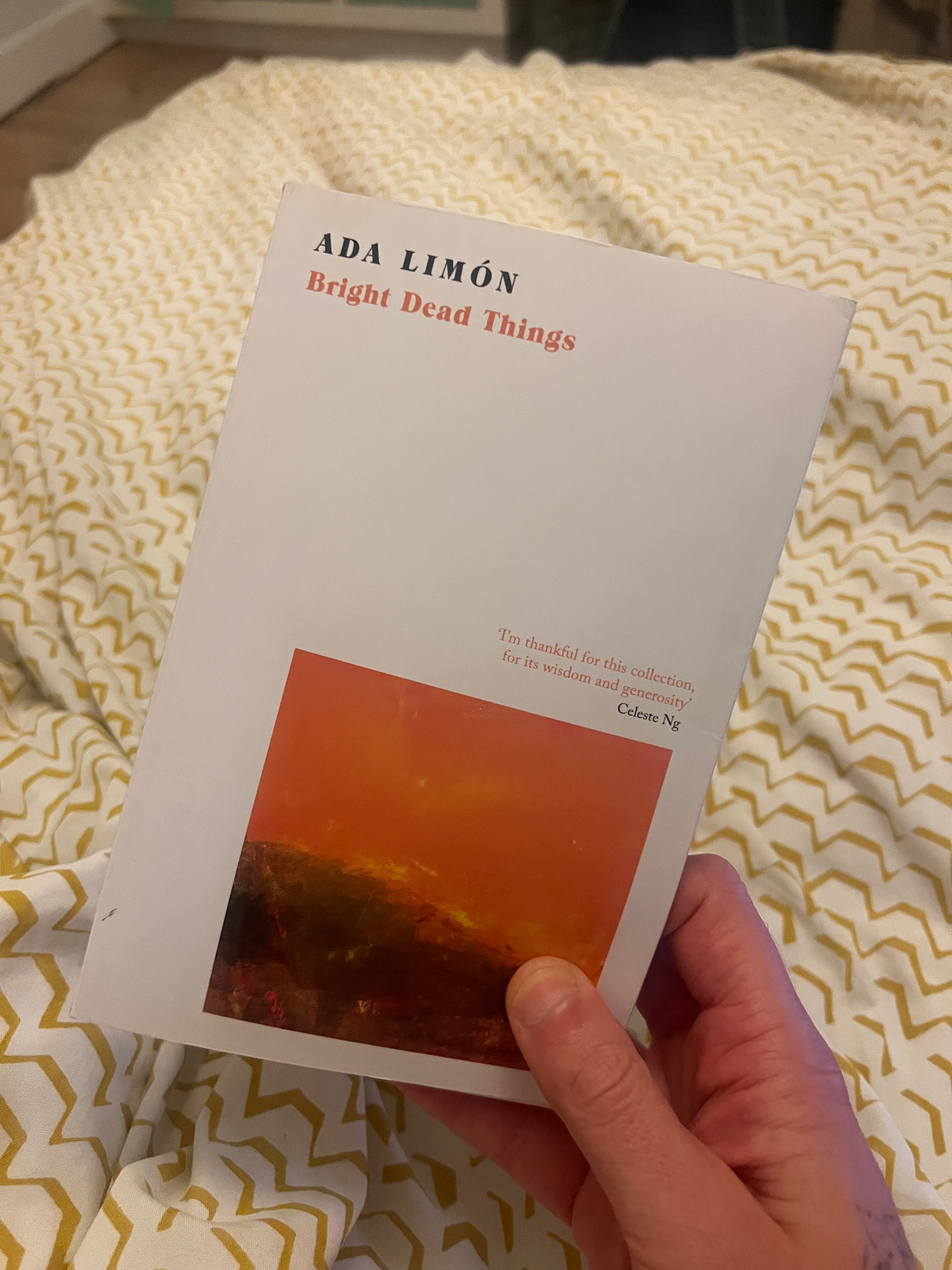
Recently I’ve been reading my first Ada Limón book, Bright Dead Things. I’d wanted to read Limón for a while, in part because she’s a name which crops up quite often when listening to contemporary poets talk about poetry or discuss their favourite poems, and in part because I heard a great podcast featuring Limón, who speaks intelligently and sensitively about what it means to be a poet. I wanted to understand what all the fuss was about.
Bright Dead Things was published in 2015, and was Limón’s first published book written after she moved from New York City to rural Kentucky in 2011. A lot of the book’s poems seem to deal with this transition, which was closely associated with Limón’s marriage; many of the poems also deal with this transition in terms of/as a part of marital life, for instance “The Last Move”, which opens with the lines ‘It was only months when I felt I had been / washing the dishes forever.’ Or “Down Here”, which opens with an observation on rural stillness:
The dog does this beautiful thing,
it waits. It stills itself and determines
that the waiting is essential.
I wanted to write about “How far away we are”, a poem from towards the beginning of the collection which made me turn back for the first page to check the book’s publication date. I wasn’t surprised when I discovered that it was published in 2015, and wanted to try and articulate some of what that intuition was about.
‘We could be in that same safe place’
From the vantage point of 2026, consumed as we are by debates about AI, seemingly surrounded by war, a sense of doom when it comes to climate change, historic youth unemployment (the list goes on!), 2015 seems almost quaint. In 2015 I had only just graduated university. Brexit and the first Trump Presidency were still a year away; Covid and its lockdowns — half a decade.
“How far away we are” seems to emanate from this different, more optimistic era, when conversation still offered the possibility of a kind of communion.
So we might understand each other better:
I’m leaning on the cracked white window ledge
in my nice pink slippers lined with fake pink fur.
The air conditioning is sensational. Outside,
we’ve put up a cheap picnic table beneath the maple
but the sun’s too hot to sit in, so the table glows
on alone like bleached-out bones in the heat.
Yesterday, so many dead in Norway. Today,
a big-voiced singer found dead in her London flat.
And this country’s gone standstill and criminal.
I want to give you something, or I want to take
something from you. But I want to feel the exchange,
the warm hand on the shoulder, the song coming out
and the ear holding on to it. Maybe we could meet
at that table under the tree, just right out there.
I’m passing the idea to you in this note:
the table, the tree, the pure heat of late July.
We could be in that same safe place watching
the sugar maple throw down its winged seeds
like the tree wants to give us something too —
some sweet goodness that’s so hard to take.
It’s funny that this poem’s title seems to preempt a reading of it as a description of a time and place which ‘we’ are now ‘far away’ from. Almost as if Limón somehow knew that this moment wouldn’t last, or perhaps the poem was already mourning something which was on its way out.1
The poem opens quite baldly with the line ‘[s]o we might understand each other better’, stating its intention that the ‘you’ and the ‘I’ of the poem — roughly, the reader and the speaker — will reach a place of mutual recognition. That is the purpose of this poem.
Then there is a straightforward, almost brusque articulation of the stakes, right in the middle of the piece: ‘I want to give you something, or I want to take / something from you.’ The play of understanding, at heart, involves just this — giving and taking.2 And the poet wants to suffer it; she wants ‘to feel the exchange’.
But it’s the last line of which I love most of all, with its dual readings: ‘hard to take’ in the sense of, ‘difficult to bear’, but also ‘hard to take’ in the sense of ‘difficult to steal, to remove.’ And that it’s the ‘winged seeds’ which are ‘throw[n] down’ — something which has wings — and should thus rightly fly — being given to us, ‘throw[n] down’ almost like a gauntlet.
This ending reminds me of the final lines of The Duino Elegies, where Rainer Maria Rilke writes of
the
overwhelming benediction
of happiness descending.Rainer Maria Rilke, The Duino Elegies (trans. Robert Hunter)
Although “How far away we are” does contain an underlying note of threat — the meeting-place of the table is ‘like bleached-out bones in the heat’; the ‘white window ledge’ / picket fence is ‘cracked’; threatening news arrives from far-off places in the world — there’s a kind of gentle resoluteness to the voice throughout, a certainty that the poem itself can at least make a consistent through-line of thought; argue its way through to the end.
Or at least the idea of that certainty is felt.
In hindsight, of course, it certainly seems that way. But who can remember what it actually felt like to live through 2015, which now seems so long ago?
One of Limón’s techniques throughout Bright Dead Things seems to be lines such as these, where the starkness of the idea underpinning the poem’s more gentle lines is allowed to break forth in clear and simple language.