
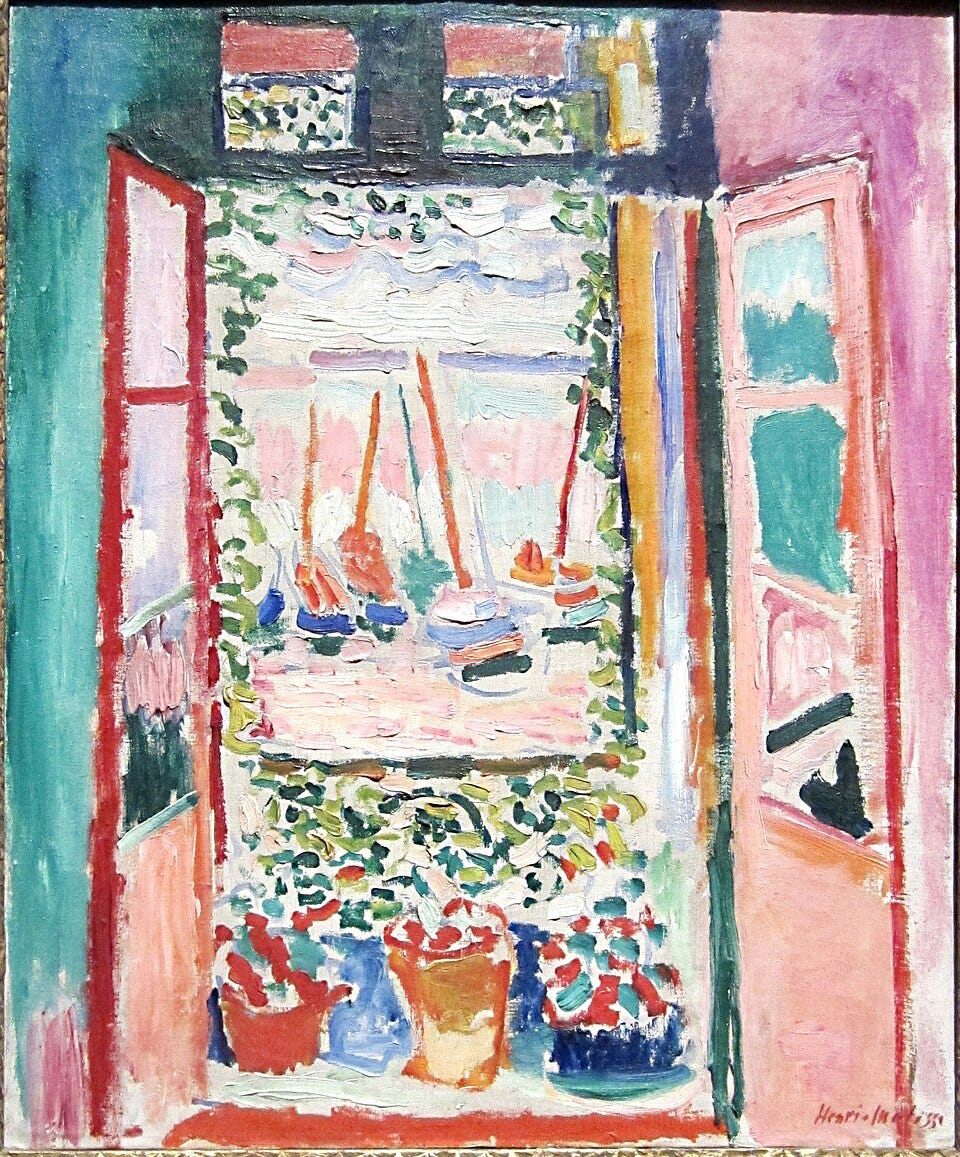
In his poetic memoir Orphic Paris, Henri Cole writes that ‘a poem must burn with a truth-seeking flame’. This is a dictum I took to heart when working on my recent pamphlet for Ignition Press, in which I returned to some painful experiences from my past and tried to turn them into art.
As Cole mandates, I felt a deep need to be truthful in my writing. One risk of this, however, is that it alienates those close to you — particularly when what’s at stake are uglier feelings (pride, anger, resentment). What if the people involved in my life at that time saw things differently? What if they aren’t poets themselves, or don’t have a way to give voice to their own perspective on the situation?
‘A poem must burn with a truth-seeking flame’ — Henri Cole
To put the question as concisely as possible: I wanted to understand how I could be truthful in my writing without being confessional. I turned to a poem that I love, Louise Glück’s “Presque Isle”, to try and understand this tension more fully.1
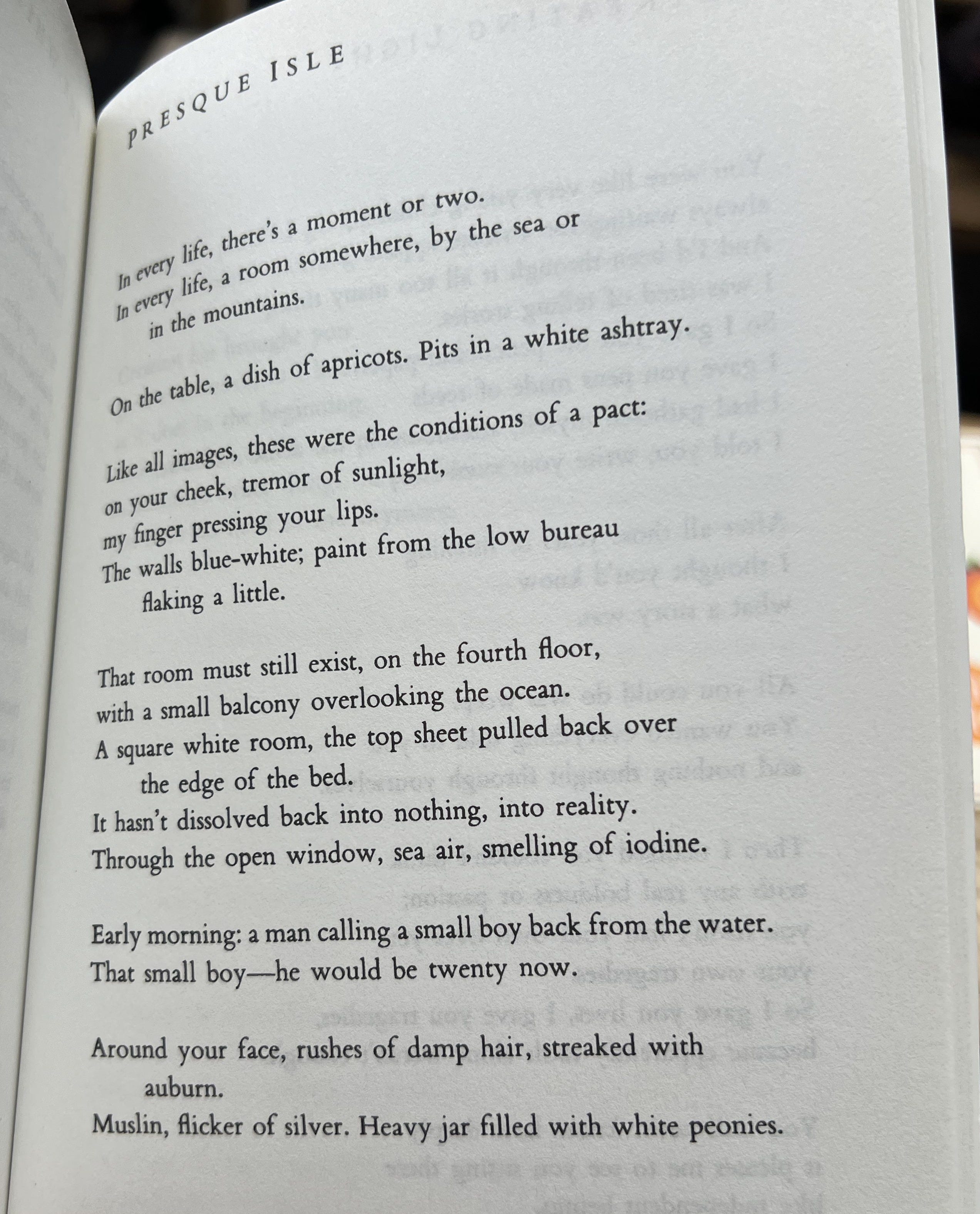
“Presque Isle” is a piece of writing that is at once intimate and universal. It opens with a couplet which describes what I think of as its givens: facts it is already assumed that the reader knows, because they have experienced such facts themselves:
In every life, there’s a moment or two.
In every life, a room somewhere, by the sea or in the mountains.
Because it is ‘every life’ and not e.g. ‘your life’, it is left up to the reader to make the conceptual jump from ‘every life’ to ‘my life — this includes my life too’.2 The reader is looped into the poem from its opening words.
Note how these lines also seem to be at once vague (‘a moment or two’, ‘by the sea or in the mountains’) but also specific (it is ‘a moment’ and ‘a room’: these are unique, identifiable, isolated instances). Even in its details the poem seems to equivocate, as if the moment described could well have taken place anywhere, at any time.
Then Glück lands the first intense moment of specificity:
On the table, a dish of apricots. Pits in a white ashtray.
The image of fruit that has been eaten, its pits placed in an ashtray, strongly suggests a moment that is already past: something is over and done with, we are entering the poem after its conclusion. The lack of verbs in the whole line underscores this reading, as does the music of the line, with its quiet sibilance and assonance.
Having situated the reader in a concrete time and place, Glück proceeds to make what sounds like an argument:
Like all images, these were the conditions of a pact:
on your cheek, tremor of sunlight,
my finger pressing your lips.
The walls blue-white; paint from the low bureau flaking a little.
Here we have a stanza which pushes the reader to understand exactly what is being said, whilst being rich in descriptive detail. It seems to be suggestive of an unspoken pact, a pact that can only be hinted at with images. However, because she does not directly describe it as such, but rather depicts it through images — the ‘tremor of sunlight’, ‘paint from the low bureau flaking a little’ — Glück leaves us uncertain as to what she is actually saying.3
This uncertainty makes the poem feel truer: on the one hand, we know that the speaker recalls this moment in its smallest details; on the other, she won’t tell us directly what that moment is, as if it is too painful to talk about directly. We know that she can remember the moment but don’t know what the moment meant.
This stanza also introduces an addressee — ‘you’. It’s unclear who this ‘you’ is. If we did know who they were, or even what role they play in the speaker’s life — lover, husband, friend — we might bring our own understanding of that to the poem, reducing its mystery and its universality.4 Keeping them anonymous serves an ethical obligation (protecting someone’s identity) whilst strengthening the emotional power of the piece. Read this way, it almost seems to me that the ‘pact’ could simply be ‘don’t tell anybody about this moment, ever’. If that’s the case, then the poem itself is an enactment of the covenant, remaining basically silent about the nature of the moment it puts forward.
The poem’s fourth stanza proceeds to insist upon — or plead for — the persistence of memory. The distinction hinges upon the ‘must’ in the opening line:
That room must still exist, on the fourth floor,
with a small balcony overlooking the ocean.
A square white room, the top sheet pulled back over the edge of the bed.
It hasn’t dissolved back into nothing, into reality.
Through the open window, sea air, smelling of iodine.
What the speaker is really arguing for here is not so much the ‘room’ itself, I believe, but rather the moment which the room evokes. It is uninteresting to claim a room must still exist — for instance, the room where I was born ‘must’ still exist in the same sense that the book I left on the coffee table three hours ago ‘must’ still be where I left it — which suggests that something else is being gestured at here.
It is the details which give it away: ‘the top sheet pulled back over the edge of the bed’, the open window with its scent of the sea. It’s not a room that’s being longed for here, but a specific room in a specific moment. The ‘iodine’ in the final line serves, I think, as a subtle hint that the speaker is trying to clean a wound.
The penultimate stanza introduces a new character:
Early morning: a man calling a small boy back from the water.
That small boy — he would be twenty now.
Is this ‘man’ the same person as the second person (‘your’) addressed in the third stanza, or is it somebody else? And the ‘small boy’ — defined solely, and repetitively, by his physical attributes — what has become of him? The ‘would’ could suggest, at best, disconnection from the speaker; at worst, it could suggest that the boy is no longer alive.
The age itself is also significant: ‘a small boy’ makes me think of a child around the age of five or six; if that child ‘would be twenty now’, then we know that the events of the poem took place a long time ago — underscoring the sense of distance and loneliness.
I think that the fact that “Presque Isle” does not grant us a definitive reading of the boy — estrangement or death or something else — is another form of withholding, which elevates its charge. We know that something has happened, but we cannot know what. In a sense, Glück is putting the reader into the same lonely position as the speaker: knowing that there is something significant here, yet feeling isolated from the truth of the poem.
In its closing stanza, the poem returns to images drawn from still life:
Around your face, rushes of damp hair, streaked with auburn.
Muslin, flicker of silver. Heavy jar filled with white peonies.
I read this stanza as a bookend with the opening still life images: as in an elegy, the poem is returning us to where it began. Cut flowers are evocative: something taken from life and turned into art, an image of the poem commenting on itself qua work of art. The ‘damp’ hair strikes a tension with the stasis evoked by the other images: even as the speaker insists on the continuing existence of the room — of memory — the description of the hair as damp evokes a sense of transitoriness, of time passing.
Conclusion
When I was writing my pamphlet over the summer I found myself wrong-footed by how much I was still affected by the things I was trying to write about. It was as if, in writing about them and trying to turn them into poetry, I’d actually brought them back to life in some shape or form. Like the room and its items in “Presque Isle”, it turned out that my experiences hadn’t ‘dissolved back into nothing, into reality’.
In its final moments, “Presque Isle” — with its image of ‘white peonies’ — seems to bring into question the very project of memorialising a given moment in art. Even art, it seems to say, can’t hold onto the past forever: cut flowers will eventually die.
In the end my pamphlet was published, people came to the launch, some of them read it and responded to it. My anxieties about honesty and truthfulness met with the real world. This turned out to be the most interesting part of the whole process: it sparked new conversations between me and some of those close to me. Far from being cut off by the publication, I think they felt that things we might not have spoken about before were suddenly on the table, like a dish of apricots, ready to be discussed.
Reflecting on this experience, and thinking about “Presque Isle”, has sharpened my sense of how to approach truthfulness and the biographical in my work. The most powerful aspect of making art isn’t that we might return to and hold on to the past, I’ve realised, it’s that it forces us to face up to who we were, what we have done, and who we might want to become. This is a project that is both specific to an individual life but also reaches out and touches other lives, indeed ‘every life’.
“Presque Isle” is from Glück’s 1992 collection The Wild Iris.
Or even ‘all of our lives’, which would do the conceptual work of including the reader in the collective.
Even the syntax of the stanza leaves things feeling uncertain: the ‘these’ seems at first to denote the ‘pits in a white ashtray’ of the preceding stanza. But the colon at the end of the first line shifts this interpretation, suggesting instead that it’s the images which follow that are the significant ones: the ‘tremor of sunlight’, the ‘blue-white’ walls.
Worth noting again that this stanza opens with an immediate appeal to the universal — ‘like all images’. Glück is telling the reader: ‘you have had this experience too’.