

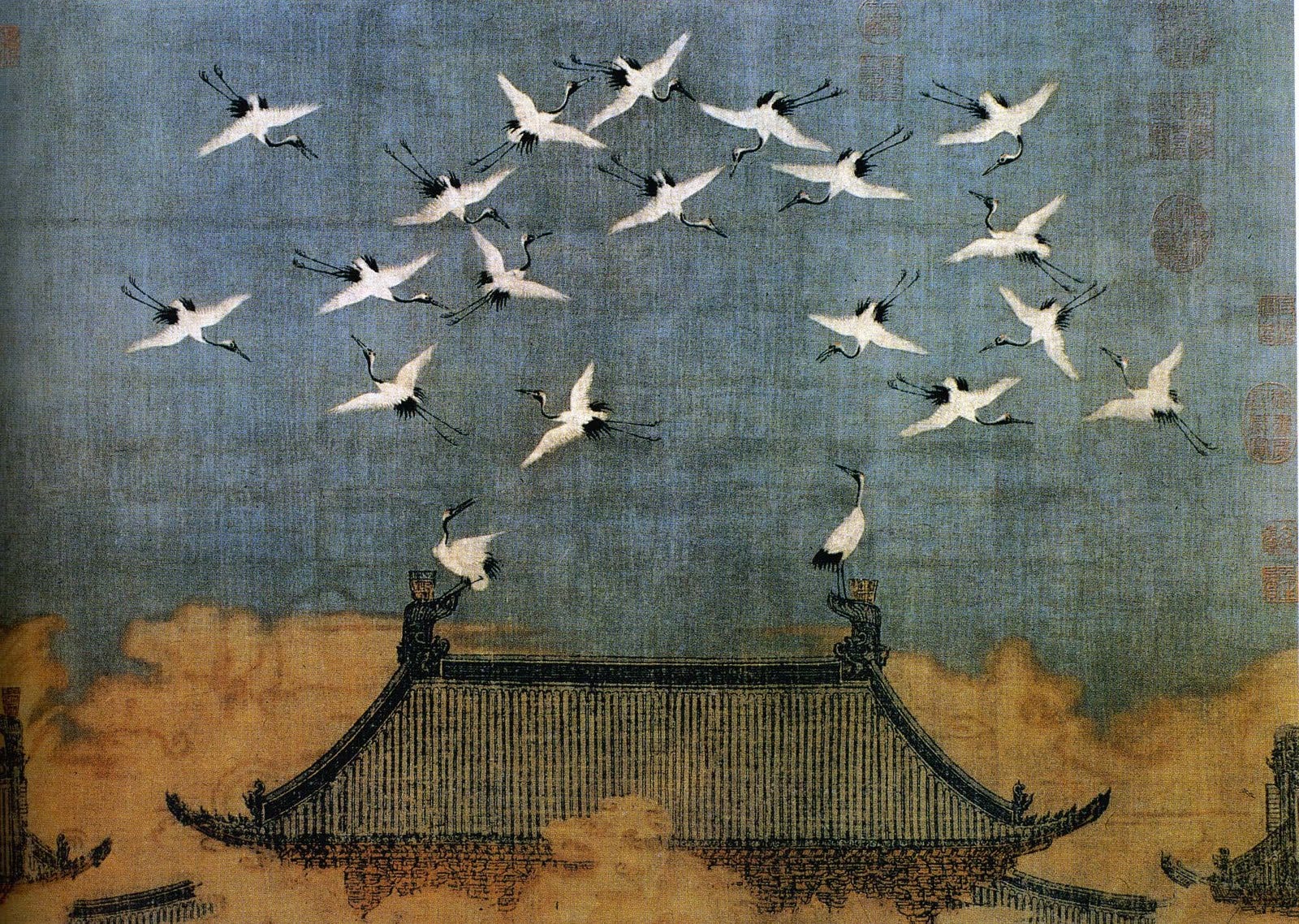
In the postscript to his anthology of masterful translations of Song Dynasty poets, Shangyang Fang writes
Ancient Chinese poets lived in close communion with nature, filling their verses with blossoms, plants, and landscapes.
The poems of the Song era are marked by a lack of articles, prepositions, and other linking words, in a way that’s evidently hard to render into English:
[…] without explicit markers such as “I”, “you,” “it,” or “we,” the distinction between observer and observed becomes blurred, leaving emotions and images to float unanchored. The language relies heavily on juxtaposition and association.1
The natural world thus takes on a heightened significance in these ephemeral verses: not only as a repository of symbolic meaning2, but also as a kind of body unto itself; in some sense, the natural world stands in for the bones of a speaker who is scantly present.
Take, for example, this translation chosen at random from Fang’s book Study of Sorrow:
After dark, coupled wood ducks
drowsing at the pond’s edge. Thin moonlightcuts through cloud to emblazon the blossoms,
whose small thumbs ply their shadows.3
The blossom’s ‘thumbs’ endow them with a seemingly human agency — even more so than the human speaker in the piece, who engages passively with music and gazing into a mirror. In poems from the Song era, it often seems to be nature which is alive and manipulating and governing the surrounding world, rather than humans.
On Saying Nothing
The poems in Joanna Klink’s latest book, Days & Chances, both ‘speak through nature’ and interrogate the first and second person as speaking voices in the poem. In this sense they strike me as having significant similarities to the Song Dynasty poems I’ve been reading lately.
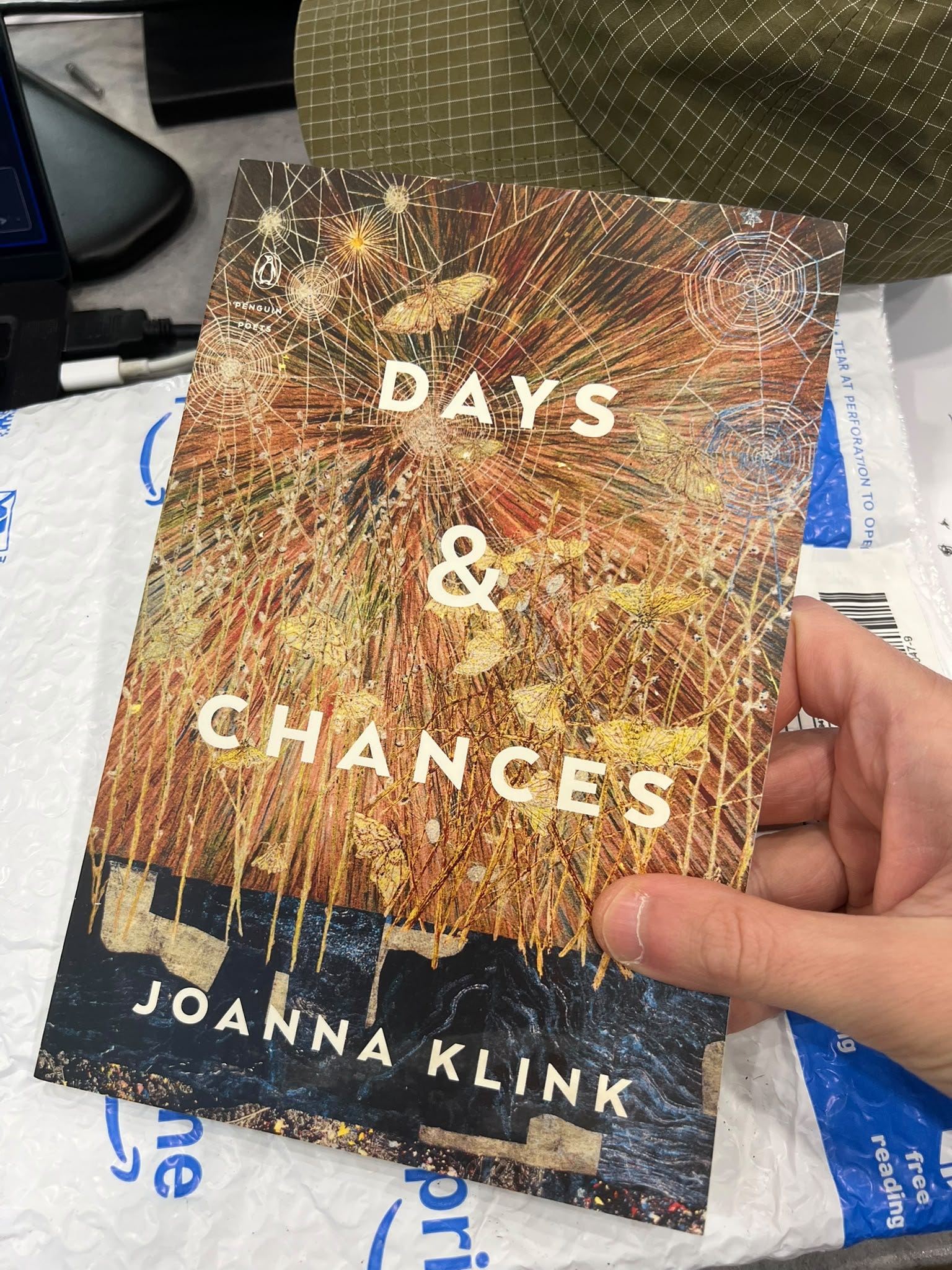
Like the Song poems, many of the poems in this book seem to be almost incidental, beginning with a description of the external world. For instance “Line From Memory”, which opens with:
Out the door now. In gathering
dusk the bridge lights have come on.
Or “Hospital Interior”:
Snow — a thin veiled wash
across the parking lot.
Or “Sand Woods”:
Returning home. No more
talk of mathematics
and Dutch history.
There is no use of personal pronouns in these openings; the world is depicted with small — almost economical — and precise brush strokes. Drawing our focus to the outer world, the speaker of these poems lives at the nexus of her observations.
But not only is the world keenly observed in these poems — forming a moodscape upon which the action of the poem unfolds — it’s almost as if the speaker is part of the exterior, natural world, indistinguishable from it:
[…] We cloud over
in plastic chairs, we
rattle drinks to cool
our throats. Whole
seasons pass
through us. A fish
leaps from a still pond.
What for?4
The self is conceptualised as a kind of landscape or perhaps a sky — something through seasons can ‘pass’, and which ‘cloud[s] over’. This is heightened, in this particular extract, by the somewhat ambiguous ‘we’, which almost seems to invite the reader into the poem.
In Klink’s new poems there is a constant play of juxtaposition; a constant restless shifting between inner and outer. This reminds me very much of Fang’s framing of the Song dynasty poems, which I cited above.
For instance, I can’t help but feel that the line ‘A fish / leaps from a still pond’ in the extract above is somehow a commentary on the preceding ‘Whole / seasons pass / through us’. Like the ‘seasons’, the fish passes from one medium (water) to another (air) and back again; it is an image of transition or motion. But its power as a metaphor (if it is indeed that) is gained purely through juxtaposition — its position within the poem, one line adjacent to another.5
IYou
Fang describes the use of pronouns in the popular ci poetry of the Song era thusly:
“I” pretend to be “you” so “I” can speak to “me” […] the “I” must first be abandoned to speak and be heard.
This idea of abandoning the “I” seems to me to be central to Klink’s poetic project. In her essay on Celan, Klink describes how a Celan poem “travels from I to you, where the you is the source of the real”6. It is from the encounter of the “I” and “you” in a poem that, writes Klink, “a world begins to emerge, to be witnessed.”
The speaker of Klink’s poems often seems to address herself in the second person, for instance in the second stanza of “Age At The Beginning of Knowing”:
Those friends and strangers, they were more
you than yourself. Now blood moves
like mist within my veins, my legs
tenuous against the dirt. Gray trees
glowing sticks bleached from winter.
Here, friends and even strangers too are “more / you than yourself”. And this encounter seems to make something happen in the poem: “[n]ow blood moves / like mist within my veins…”, writes Klink, as if the recognition in the previous sentence has caused the blood to start moving in the “tenuous” legs of the speaker; as if this encounter with the outside has itself caused life to happen. Suddenly even “[g]ray trees” are “glowing sticks bleached from winter.”
In Song-era ci poetry, the poem was a straightforward form of ventriloquism: frequently composed by men who desired other men, these poems were intended to be sung by women. They were a way of one man communicating his feelings to another in a way that was socially acceptable, at a time when public displays of homosexuality were forbidden. In Klink’s work, the play of pronouns seems to be part of the poet’s project of locating a self which she describes in “Two Trees” as “[…] always / unsure. Merely in attendance / on the good days.”
Stepping Away
Perhaps it’s just because I’ve recently been reading a lot of Song Dynasty poetry whilst simultaneously thinking about Joanna Klink’s poetry that I’ve noticed the similarities between pieces of art created over a thousand years apart. But poetry is weird, particularly poetry which really tries to probe at the essence of what it means to be here, now. What’s interesting is that Song-era poetry came about in the way that it did in part because of a specific cultural context, very different from the world we inhabit in 2026. Trying to think about that context and why it led people to craft poems in the way they did can perhaps offer useful angles on understanding a contemporary poet whose work can sometimes seem evasive and unclear, who is trying to use her craft to get at the essence of being.
Fang gives a great example of this in his postscript, offering a ‘word-by-word reading’ of a poem by Du Fu: in English, the poem effectively reads as a long series of nouns. It’s not clear who in the poem is speaking, nor what action (if any) is taking place. If anything it’s closer to painting than poetry: a totally different experience to what a reader of English poetry will find.
Fang gives the example of plum blossoms which, flowering as they do in the dead of winter, serve as a symbol of purity and perseverance.
Zhang Xian trans. Shangyang Fang, “To the Tune ‘Tian Xian Zi: Goddess’”. From Study of Sorrow.
What’s interesting about this technique of juxtaposition is that it implies a strong relationship of trust with the reader: without giving any signalling (e.g. “like” or “as if” — the obvious cues of a metaphor), you have to really believe that the reader will do the work of relating one phrase to the next, turning it over and understanding how two seemingly disparate lines do in fact speak to one another (or, perhaps, do not). You have to trust that the reader can pay attention to your poem.
This is perhaps not so dissimilar to visual art, which, rather than time, unfolds in space: here, a key technique is (visual) juxtaposition. I’m not sure it’s particularly to germane to Klink’s writing, but I’m reminded of André Breton’s infamous statement that art should be “as beautiful as the chance encounter of a sewing machine and an umbrella on an operating table”. In Surrealism, the onus is very much on the viewer to make sense of the artwork.