
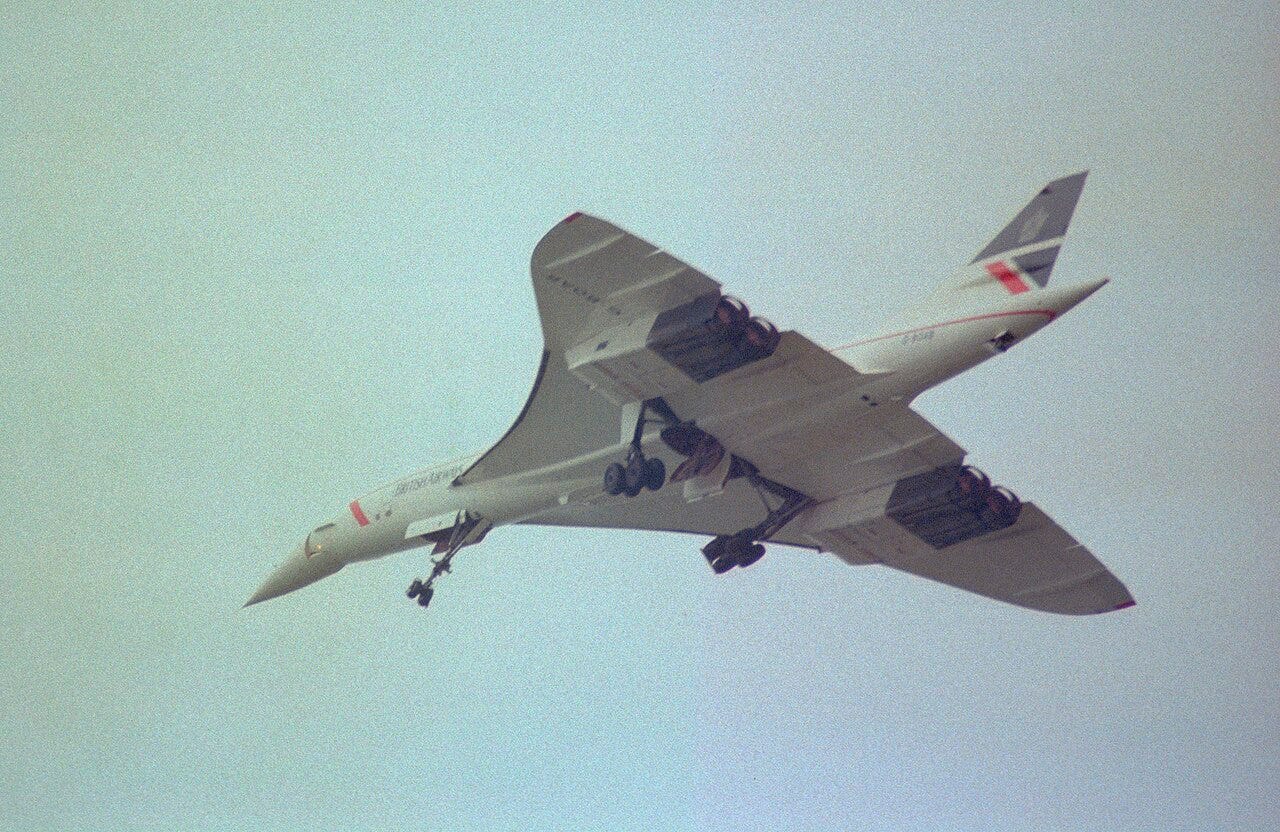
In a previous post, I described some of my motivations behind writing about Concorde, the supersonic aircraft which flew from 1969 to 2003.1 In this and further posts, I wanted to dig into some of the more technical aspects which make Concorde interesting from a design and engineering point of view.
The designers of Concorde had to reckon with a conundrum: this was a plane that moved between two worlds — that of subsonic and supersonic flight — and yet a jet engine is strictly confined to the first of those worlds, only able to breathe air that travels slower than the speed of sound.
To solve this problem, engineers equipped with little more than slide-rules and primitive computers devised an engine intake which used a series of controlled shockwaves like tiny detonations to slow the air down to subsonic speeds before it met with the compressor face.2
This intake helped Concorde achieve what no other supersonic passenger aircraft had achieved, before or since: sustained cruise at supersonic speed without the use of afterburners.3 Passengers were able to enjoy a first-class service of three-course meals with champagne and cocktails as the plane blazed along at twenty-three miles a minute, barely even registering that the plane had gone supersonic.4
It’s also a brilliant lesson in how a design constraint can be turned into an advantage. This post explains in moderate depth how it was achieved.
Shockwaves and the sound barrier
A plane moving through the sky at subsonic speeds is best thought of as a swimmer floating lazily in a pond: ripples spread out in all directions, notifying the water of his presence.
Similarly, a plane’s forward motion in the air causes air molecules up ahead of it to vibrate; in effect, it warns them to get out of the way. These warnings waves or pressure waves travel at the speed of sound.
Beyond the sound barrier, however, there’s no time for the air molecules to receive a warning: they pile up and form into thin, sudden boundaries, referred to as shockwaves, flowing into a cone shape around the aircraft. It’s as if the swimmer has started crawling steadfastly through the water, striving to reach the opposite shore — his wake spreads out around him in just such a cone or “V” shape.
When air travels across this barrier of shockwaves it slows down and gets compressed, increasing in pressure and losing both energy and pressure. This is bad news if the shock is uncontrolled because a jet engine needs a smooth, reliable flow of air; sudden changes in airspeed or pressure can cause it to stall.
It gets worse, however: not only do shockwaves cause trouble at supersonic speeds, but as previously mentioned, an engine can’t handle supersonic air at all — it needs air travelling at slower, subsonic speeds. Concorde’s intake needed to slow down air and also somehow serve as a shield against shockwaves, a kind of protective atmosphere sheltering the required slower subsonic world of the compressor.
Solution: a variable intake geometry
“[T]he air intake in front of the Olympus engine is a piece of wizardry. There is no doubt about it. Here is why.” — BAC/Aérospatiale Concorde, Owners’ Workshop Manual, p. 76
Research in the 1940s had shown that the shockwaves forming at supersonic speeds could be generated in a controlled, repeatable fashion; this meant that, given the right sort of intake, shockwaves could be used to Concorde’s advantage.5 Accordingly, Concorde’s intake was designed so that shockwaves were generated on purpose as high-speed air entered the shaft, causing the air to dramatically slow down.6
Consisting principally of two hydraulically-controlled ramps along the roof of the shaft which led to the engine, the intake worked like a pupil, dilating and contracting in response to changes in the ambient light (airflow).
This is the “variable” part: as the plane accelerated through the sound barrier, the shape of the intake could change to ensure that shockwaves continued to form at the optimal angles.
At takeoff, with the “pupil” enclosed in a kind of darkness, the intake would remain fully dilated to permit as much air as possible to hit the hungry compressor face. As Concorde approached supersonic speeds, the intake would then begin to contract, restricting airflow towards the engine and starting to generate a series of controlled shocks.
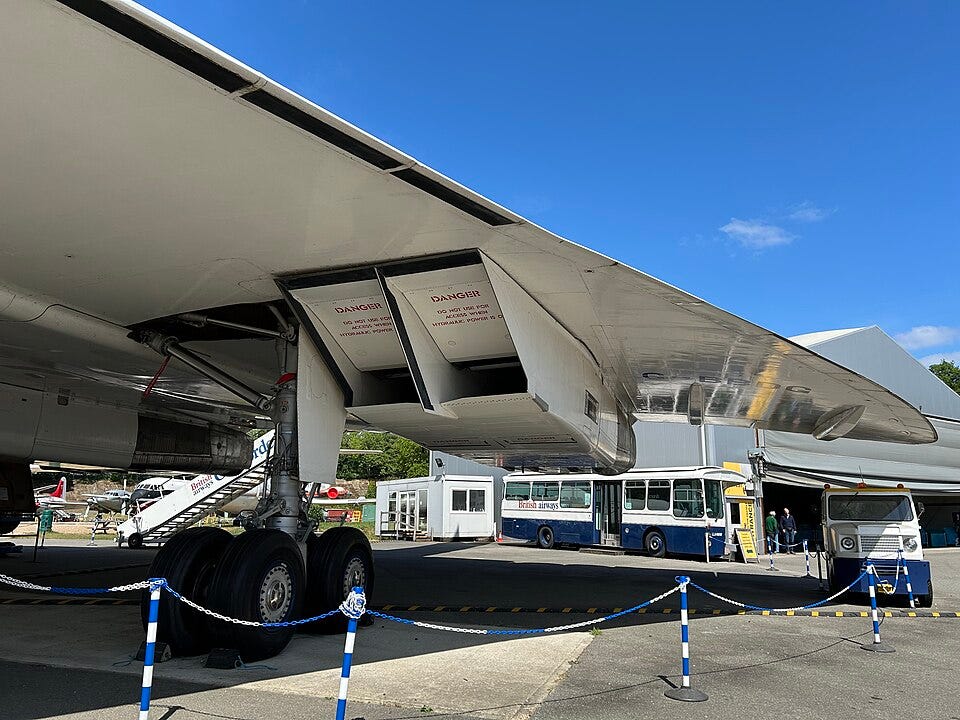
These shocks were generated in two main phases:
Moving the front ramp downwards meant that the intake narrowed from its opening until about halfway along: this oblique angle caused a series of controlled shockwaves to form, slowing the airflow down in degrees. By the end of this process, air which had previously been moving at around Mach=2 was travelling at a much slower Mach=1.3.
A final terminal shock at the end of the first intake ramp brought the airspeed to below Mach=1, suitable to be fed to the engine.
Using a series of oblique shocks as the main mechanism to slow down incoming air meant that less pressure was lost in the process — this is good, because a jet engine needs high pressure air to work efficiently.7
Once the air had reached a subsonic speed — about halfway along the intake — the angle of the second ramp resulted in a slightly widening stretch up to the engine face. Because subsonic air increases in pressure as it passes through a widening duct, this allowed the intake to recover some of the pressure lost to shockwaves.
The total effect of this intake was to cut airspeed from about 1,350mph at the front of the intake to about half the speed of sound at the engine (compressor) face, over the course of three-and-a-half metres, with limited loss in pressure. And it did this by leveraging shockwaves — one of the principle things making supersonic flight so challenging.
Moreover, sculpting the airflow in this way meant that roughly 60% of the total net thrust produced by the powerplant actually came from the intakes themselves, not from the engines.8 Such efficiency enabled Concorde to cruise for hours in supersonic flight.9 People tend to imagine that the thrust produced by a jet engine comes mostly from burning fuel, but that’s only half the story: the engine uses some of the energy from the air, too. That Concorde could do this at such high speed, as its fuselage heated up to almost 100 degrees centigrade, is remarkable.
André Turcat — the chief flight test pilot of the Concorde on the French side, and the first person to actually fly the prototype plane after it rolled off the production line in early 1969 — commented that
[the] system of variable geometry intake is really the big new feature of [Concorde], more so than the delta wing form or the flying control system.
And yet — probably because it’s largely invisible, or frequently mistaken for the engine itself — the intake is the part of the plane that fewest people know about.
Coda: digital electronics
As a software engineer in my day job, it’s satisfying to note that the the ramps forming the variable geometry intake were controlled by digital computers, which was — as far as I know — unheard of at the time.10
Data was routed from sensors on the outside of the aircraft which measured airspeed and pressure into a set of control units located in the rear of the aircraft. These control units — basically specialised computers — both monitored the system as a whole and were also continuously performing the complex calculations necessary to determine the optimal angle of the ramps which made up the variable intake.
I haven’t yet looked into this part in detail (and I’m sceptical about how much information will be available online), but I might write a post about the software used here in future.
Conclusion
“Well-designed systems turn their weaknesses into strengths.” — Sean Goedecke
As its name suggests, the variable intake geometry could dynamically change shape as Concorde flew higher and airspeed increased, sculpting the airflow to the needs of the engine at any particular moment in time.
It did this by generating a series of shockwaves at the front of the intake, constantly dilating or contracting in real time like a pupil, to ensure that shockwaves formed at optimal angles.
This was brilliantly smart on the part of a designers, and a great example of how a serious design constraint — the need to protect the compressor from shockwaves — was turned into an advantage, resulting in a highly efficient intake which actually made supersonic cruise possible.
Whenever we’re making things — be they planes or poems — I think we should always be attentive to how we can turn weaknesses into strengths. As it was in Concorde’s case, the right design is usually the one that’s best adapted to the realities of its environment.
The first commercial flight was in 1975.
You can think of the intake as a kind of metal throat leading towards the engine.
An afterburner is a device fitted to the back of the jet engine — that’s the “after” part — which pretty much dumps extra fuel straight into the stream of hot exhaust gases coming from the tailpipe. The fuel ignites — that’s the “burner” part — and provides extra thrust to the aircraft.
Concorde did in fact have afterburners fitted to its engines: it used these to push through a high-drag area of the supersonic flight envelope known as the transonic region — from about Mach 0.8 to Mach 1.2. It would also sometimes use afterburners to provide extra thrust during takeoff on warm days.
The only other supersonic passenger aircraft ever fully realised — the Soviet Tupolev Tu-44 — was only able to achieve sustained supersonic flight through continuous use of afterburners. This made it both very expensive to fly (lots of fuel) and also excruciatingly loud for passengers onboard, in an age well before noise-cancelling headphones.
If it weren’t for the famous “machmeter”, a digital display at the front of the cabin which showed how fast the plane was currently travelling in terms of Mach units.
The research was originally carried out in Göttingen by Klaus Oswatitsch; it was first published in English in 1947. Oswatitsch’s work focused on pressure recovery in supersonic flight for missiles.
This trick had previously been used on several military jets, so wasn’t new; the novel part was that the intake could change shape across the flight envelope.
Recall that air passing across a shockwave loses pressure, as well as slowing down.
“Powerplant” is a term used in aviation literature to refer to the intakes, engines and afterburners taken together.
Cruising at supersonic speed is often referred to in the literature as supercruise, which is quite a nice term.
The original intake system on the two prototypes had been controlled via an analogue system, which proved to be not sophisticated enough to provide reliable, subsonic airflow at all stages of supersonic flight. It was switched out late in the development process for a digital system procured from British Aerospace systems, which had originally been designed for missile guidance.
Using this kind of system on a civil aircraft was another first for Concorde.