
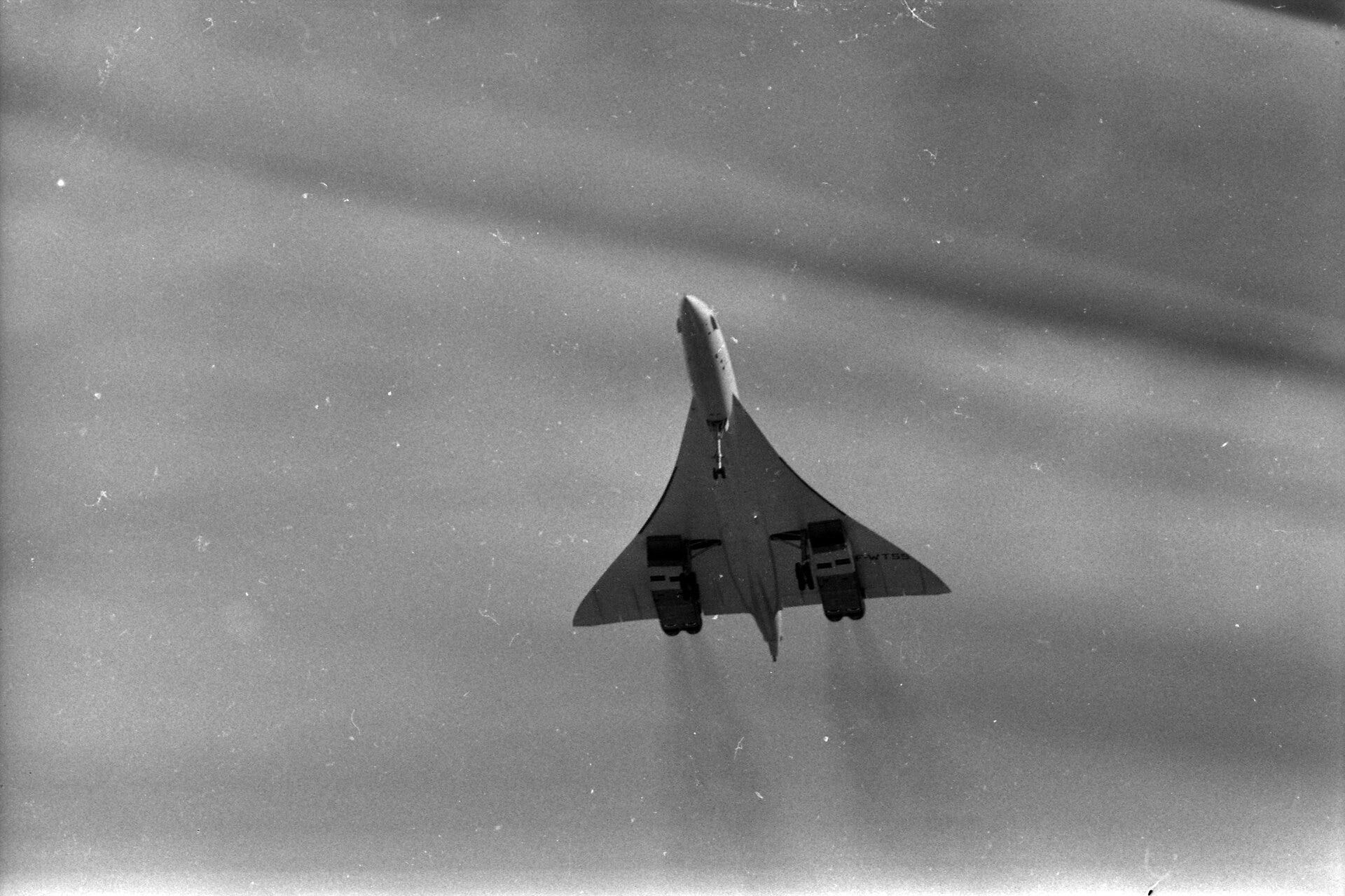
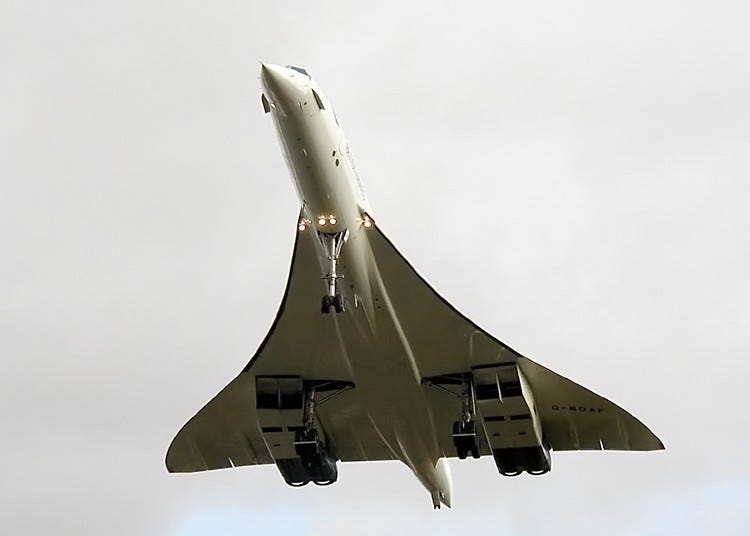
Up until some time in 2003, I watched Concorde fly over my house on its final approach into London Heathrow. Twice a day I would hear that signature sound: a low, sonorous roar, rattling windows throughout the neighbourhood and making all of us look up. With its slender, aquiline profile, Concorde was an ode to ‘60s utopianism somehow stranded in the grimy London I remember from the ‘90s. Its daily arrival — after a long, lonely transatlantic crossing — seemed to suggest something momentous was happening, or about to.
When I started working on my upcoming pamphlet for Ignition Press in June this year, it was on the back of having been interested in Concorde or the idea of Concorde since I was a child; I’d written a poem (now lost) about Concorde as a teenager, back in 2011 or so. That poem’s tone was elegiac, addressing the plane in the second person — the only line I remember was something like “vanishing, you have become less than air…” — as if Concorde had been less a machine and more a person whose loss I was grieving, despite never having flown on her.
Still, I wasn’t really sure what story I wanted my pamphlet to tell.1 I had written five or maybe six poems about Concorde when I first sat down with Isabelle, my editor, and she asked what flying “faster than the speed of sound” — the pamphlet’s title — meant to me. At the time — in spite of having been notionally working on the project for several months, and having been preoccupied with Concorde for most of my life — I didn’t really know how to respond.
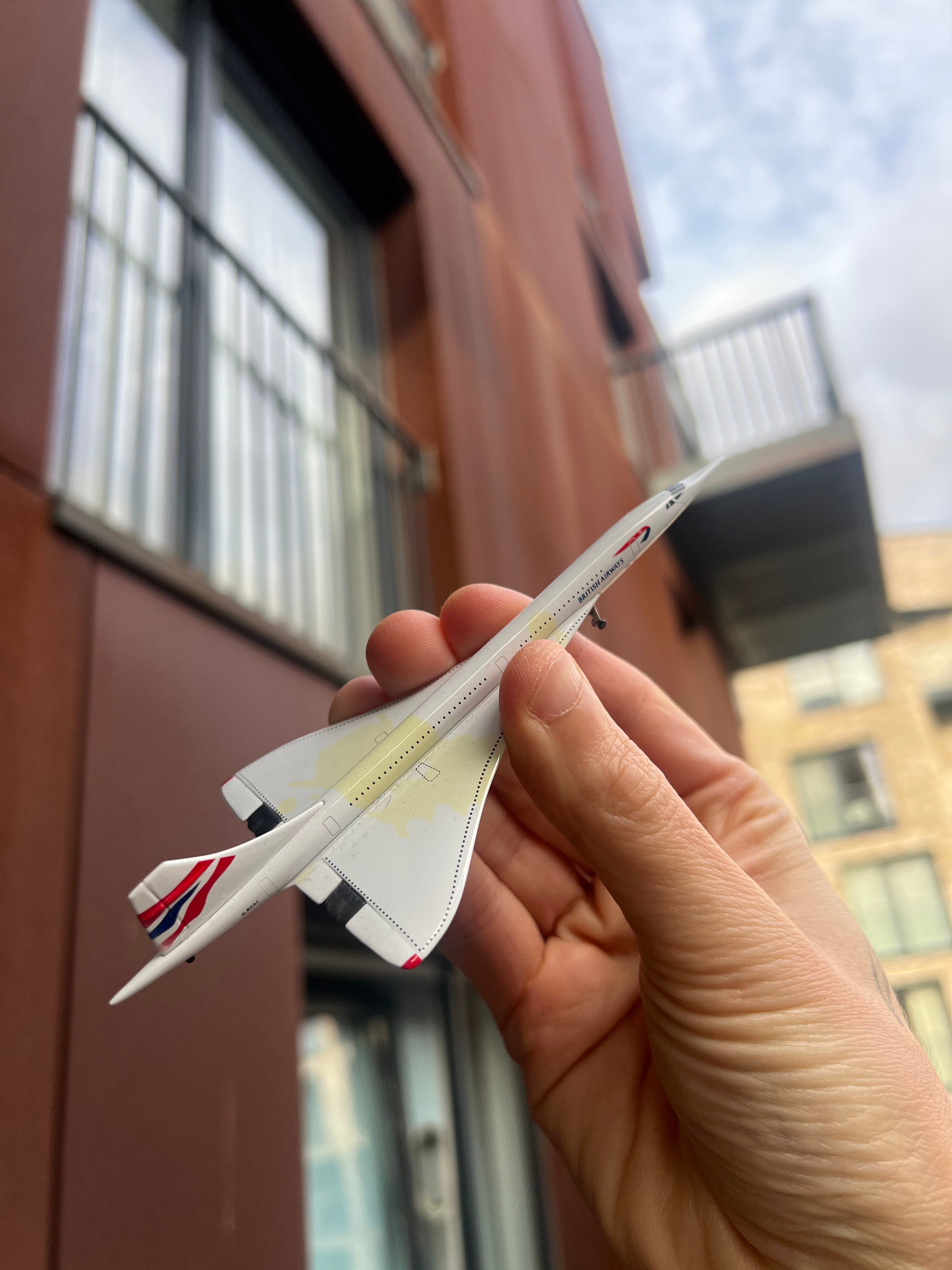
Concorde was retired in 2003, when I was ten years old. Its story, for those who know something about it, is often couched in terms of “what if”: what if the US Congress hadn’t banned supersonic overflight of the US mainland? What if the plane hadn’t crashed disastrously in Paris in 2000? What if the British Government of the 1960s and early ‘70s had been steadfast in its support of the more advanced “Concorde 2”, which would have increased the plane’s range and reduced its fuel consumption?
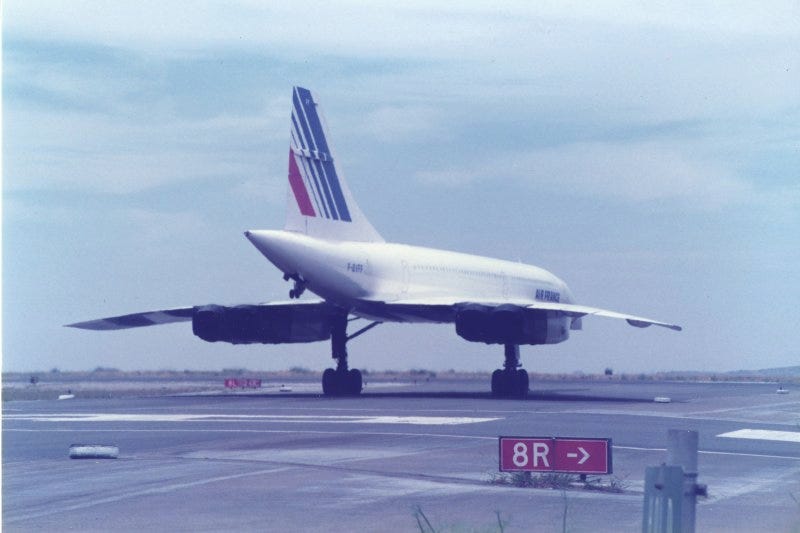
In the event, having originally projected orders for over one hundred planes, only fourteen commercial units were ever produced (seven each for British Airways and Air France, who remained quite cool on the whole project until its conclusion). Concorde’s cabin was cramped — its shape being constrained by the physics of high-speed flight — it was expensive to fly, it required skilled pilots, and its range was limited.2 Finally, concerns over the sonic boom meant that Concorde’s flight paths were severely curtailed by governments around the world, effectively rendering it uncompetitive on many popular routes.3
Although it seemed powerful and mysterious, the Concorde I watched as a little boy — on its twice-daily transatlantic crossing, linking London and Paris with New York — was, in reality, not much more than the postscript to a much grander vision of a globe shrunken and made friendly by supersonic flight, a vision which never came to pass.
It is hard not to see images of the plane — which seemed to promise so much, and became such a symbol of beauty and elegant design — and not feel a pang of melancholy. What if it were still flying today, cruising at 50,000 ft and giving its passengers a glimpse of the curvature of the earth, the beginnings of space?
Ultimately, many of the poems in the pamphlet I wrote ended up touching upon some painful experiences I’d had when I was younger, in particular having suffered with an eating disorder. This was present in the earliest poems which formed the project, so it was a natural avenue for me to explore, and one in which I was encouraged by Isabelle. Still, I was surprised by the extent to which this theme made itself known during the writing process.
For many of those who suffer from them, an eating disorder can hold out the ever-unfulfilled promise of utopia, something always almost there, just across starvation’s horizon. One has the feeling that, if one could only persist in not-eating just a bit longer, then — somehow, inexplicably — the entire world would be transformed; the face of God would be revealed. How different is that to the story of Concorde, at heart?
When I first started treatment for the eating disorder, after graduating in my early 20s, I told my therapist that I felt as if the film of my life had finished: “the credits have rolled,” I said, “but I’m still here.” This was in the summer of 2015: Concorde had been gone for over a decade, and yet my body remained.
At least in my experience, I think this gap is one of the principle sources of human disappointment: the world continues in spite of the dreams we make of it.
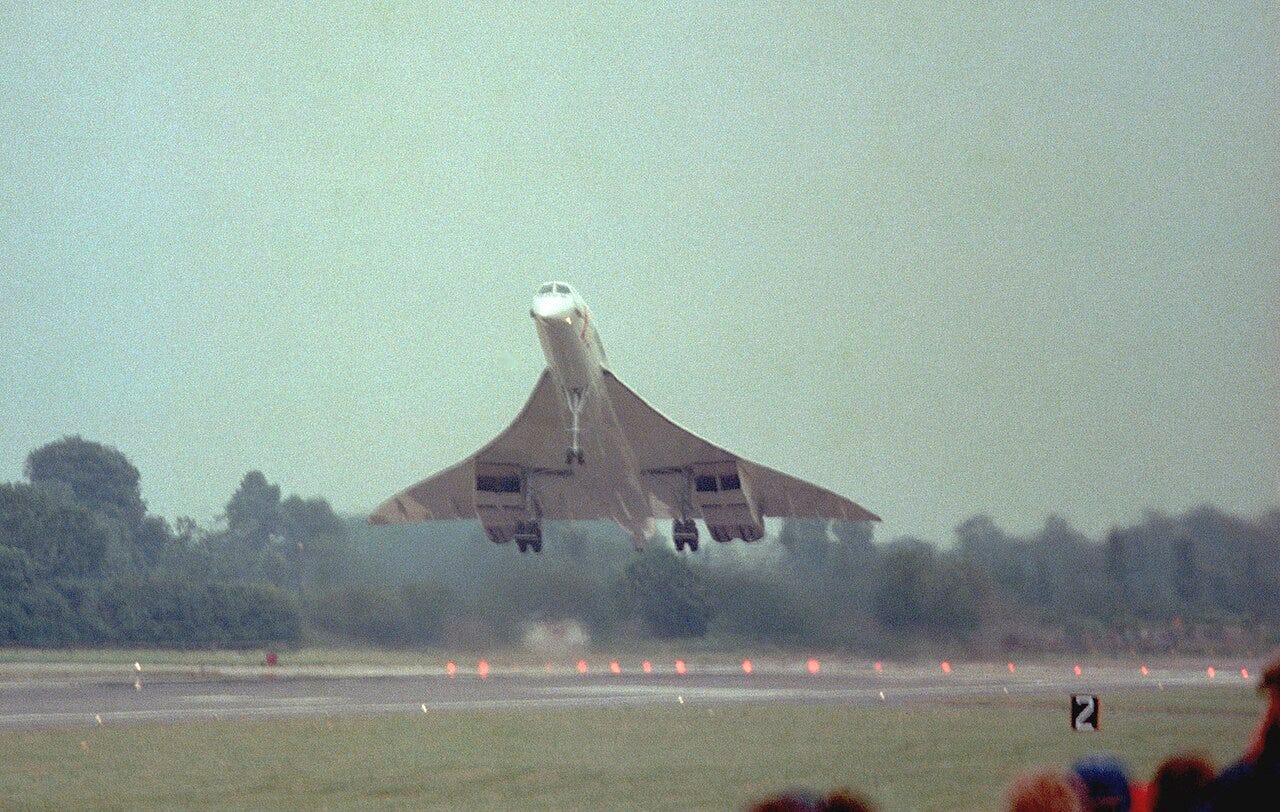
Another idea which caught my attention as I was researching Concorde whilst writing the pamphlet was that of duality. Without getting into too much technical detail, one of the main challenges of supersonic flight is that air behaves very differently above the sound barrier — almost inversely to how it behaves at subsonic speeds.
Design choices which seem sensible when an aircraft is travelling along at three or four hundred miles an hour suddenly make no sense when the same aircraft is travelling at more than a thousand miles an hour (and vice versa). This means — and meant — that any aircraft which wants to regularly traverse the sound barrier must effectively hide two quite different planes in a single body.4
This resonated very strongly with me: the sense of seeing something in the mirror which isn’t what others see, the deep conviction that somehow whatever is “inside” of you will never fit into the world “outside”, and so on — and of course the sense of shame associated with that kind of mindset. Eating disorders — falling as they do on the dusky fault line between the mind and body — are disorders of duality. They are deep fissures in the self. To suffer from them is to be constantly traversing this line, often acting as one imagines a “normal person” would, in order to simply fit in.5
As the child of a teacher who later grew up to be a software engineer, it’s perhaps not a surprise that I always loved understanding and explaining how things worked.6 Yet as a child I only knew Concorde superficially — when looking up, or playing with one of the (many!) toy models I owned. It’s surprising to me — sitting here now, writing this — to think that I only took the time to really understand how that thing worked many years later, long after it was gone. Some things can hold our attention for years before we see what secrets they have to tell us.
I embarked on the pamphlet project as I do most things in my life: with a kind of engineer’s naïve optimism — “spotlit and confident”, to quote a line from a favourite poem — that I knew what I was getting into and roughly how I was going to go about it.7 I think I believed — mostly unconsciously — that writing about my past would give me some measure of control over it; I was going to tell the story of what had happened to me on my own terms, at last. Perhaps in a sense I wanted to get revenge on it.
But if I learned anything from the editing process, it was how painful many of those past experiences still are for me, how close they still feel. By the end of the roughly three-month period of editing work I felt exhausted, emotionally used up, and reluctant to give any more to the project. It simply felt too painful to go back there, or perhaps too painful to bring those experiences back into the forefront of my life. Yet at the same time I felt as if I didn’t have a choice.8 Somehow I felt I owed it to myself.
Writing, introspection, patience — taking time to understand and honour the craft and labour which goes into things — is certainly one way I’ve found of coming to terms with the gap between reality and what we make of it. This is how we clear space for something new and fertile to emerge: a process of reconciling and (re)orienting ourselves towards the world. I don’t believe it’s easy, but it feels as if it might allow us to live a bit more honestly. I think this is what compels me to do it.
Faster than the speed of sound will be launched on November 21st at the Poetry Café in London (TBC). Watch this space for further reading updates.
Faster than the speed of sound, forthcoming in November 2026.
Jet engine fuel was plentiful and cheap in the ‘50s and ‘60s; the first oil shock in the early 1970s — shortly before Concorde’s first commercial flight in 1975 — suddenly rendered it a precious commodity, which needed to be used sparingly.
Famously the American Congress banned supersonic flights over mainland US (excluding military jets). It’s widely acknowledged that this was a protectionist measure: the American supersonic civil transport project had ended in failure, and — in spite of Concorde orders being placed by several important American airlines (all of which were ultimately cancelled) — the US government took steps to protect its commercial interests, by attempting to shut out foreign competitors.
Many other governments followed suit: there were basically no places on earth which permitted supersonic overflight over land.
A good example of this in Concorde’s case is that the airframe would expand by up to a foot when cruising at supersonic speeds (due to an effect called kinetic heating which sets in during high-speed flight; the tip of the nosecone reached temperatures of around 120° centigrade). Everything had to be designed with this duality in mind.
I think the experience of growing up gay in the late 90s/early 2000s also fits into this sense of duality: presenting one face to the outside world and keeping your inner life — the world of desires — carefully hidden away.
Random memory: my first primary school “certificate” — a kind of weekly award given out to kids who’d done something praiseworthy in that week — was for explaining to a group of students how to send an email on one of the school’s primitive (at the time) Macintosh computers. That must have been in 1997 or 1998; my class teacher was corresponding with a fellow teacher in Denmark, I recall.
The poem is “Elemental” by Joanna Klink, from her 2015 book Excerpts from a secret prophecy.
And not simply because I was under contract!